ban111

Home         Binoculars        Cine Collection         literature          About Us          Ask Expert         Items for Sale      FAQ        Contact


  The list of the binoculars literature          Page 2                             Page (1) (2)
  Dictionary

I. The list of the binoculars Literature. The list will be extended.


In English language:

1. Dr. Stephen Rohan – Eyes of The Wehrmacht.  An illustrated guide to The German World War II;  10 x 80 Binoculars; Volume I. Published by Rohan Optical Press Bradbury, California 1996 

2. Dr. Stephen Rohan – A Guide to Handheld Military Binoculars 1894-1945. Published by Optical Press Bradbury, California, 2001(ISBN 0-9709003-0-9)

3. Robert Forslund – Swedish Military Binoculars. The Best Possible Binoculars. Leezen 2009

4. William Reid – Barr & Stroud Binoculars and The Royal Navy.  Published by National Museums of Scotland, Edinburgh  2001 (ISBN 1-901663-66-3)

5. R.C. Gregory – Notes on Binoculars and their use. Published in 2003 (ISBN 0-9544050-0-5)

6. R.C. Gregory M.A. - Fine Binoculars of The Twentieth Century. Published in 2004 (ISBN 0-9544050-2-1)

7. R.C. Gregory M.A. - Binoculars: A Pocket Guide. Published in 2005 (ISBN 0-9544050-4-8)

In German language:
1. Liste der Fertigungskennzeichen für Waffen, Munition und Gerät (Nach Buchstabengruppen geordnet) Berlin 1944 Gedruck im Oberkommando des Heeres. Originalgetreuer Nachdruck, herausgegeben von Karl R.Pawlas, Publizistisches Archiv für Militär- und Waffenwesen. Nürnberg 1977  (ISBN 3 – 88088 – 214 – 2). [‘List of Manufacturer’s Marks for Arms, Ammunition and Implements’ that had been edited in 1940 to 1945 as a secret publication by the Supreme Command of the Army (Chief of the Army Armament and Commander of the Reserve Army) Army Ordnance Department Wa Z 2. ]

2. Karsten Porezag - Hensoldt. Geschichte eines Optische Werkers in Wetzlar. Band 1: Familien- und Gründungsgeschichte bis 1903. Published in 2001 Karsten Porezag, Wetzlar (ISBN 3-9807950-0-4) - Hensoldt - History of an optical company in Wetzlar. Volume 1: Family History and founding of the Company until 1903. The translation of the title into English, by Google language tools.

 3. Hans T. Seeger - Felstecher. Ferngläser im Wandel der Zeit; Germany Hamburg 1989. Binoculars. Binoculars through the ages. The translation of the title into English, by Google language tools. (read book)

4. Hans T. Seeger - Militärische Ferngläser und Fernrohre in Heer, Luftwaffe und Marine;  Military Binoculars and Telescope for Land, Air and Sea Service. Germany Hamburg 1995; ISBN 3-00-000457-2. The title of the book is in German and English language. (gray book)

5. Hans T. Seeger - Zeiss-Feldstecher Handferngläser von 1894-1919. Modelle - Merkmale - Mythos. The book is in German language. Zeiss binoculars  hand binoculars from 1894-1919. Modles - Features - Myth - the title translated by Google. Dr Hans T. Seeger, Hamburg 2010, ISBN 3-00-031440-7. (blue book)

In Polish language:
1. Antoni M.Piaskowski – Dawne Lunety I Lornetki W Zbiorach Polskich; Warszawa 1996 (ISBN 83-901353-7-X) ) -  Old lunettes and binoculars in Polish collection.

2. Piotr Matejuk – Wojskowe Przyrzady Optyczne w II Rzeczpospolitej;  Published by Bellona, Warszawa 1997 )ISBN 83-11-08675-3) ) - The military optical instruments in the II Polish Republic.


II. The Dictionary
 History of binocular construction according to Dr. Stephen Rohan description in book 2 (no. 2 in the list-above)

- Galilean binoculars, Non-prism binoculars

’Galilean binoculars’ were named after Galileo Galilei, the Italian astronomer. These binoculars consist of convex lenses for the objectives and concave lenses for the eyepieces; they form upright images. Galilean binoculars feature neither high magnification nor a wide field of view.

- Relief Fernrohr (teleplast)

Originally patented in 1894 by Ernst Abbe of Carl Zeiss. The Relieffernrohr can be used in the horizontal position for increased stereoscopic affect and in the vertical position for increased height to look over obstruction.

- Original Porro Abbe I type prism system

Originally patented in 1894 by Ernst Abbe of Carl Zeiss, Jena Germany. The prism system was separately invented on the same principle of the invention  of Ignazio Porro in 1854. Called the Abbe-Porro system often shortened to Porro I Prism system.

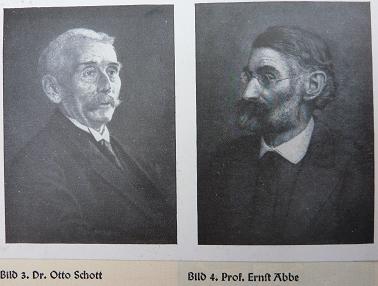
                                                   Abbe & Schott;125  
    
            Two the most important men in the history of Carl Zeiss Jena; The picture from Carl Zeiss Catalogue - December 1936, in our collection
 
- Modern Porro I Prism system
The
Ignazio Porro prism system was not successfully put into production until Ernst Abbe, later independently, invented the prism system working with Carl Zeiss. Abbe’s system also gave a more stereoscopic effect, which was important in the patent. The Porro Abbe is widely used in binoculars today. Porro prism binoculars have a simple, rugged construction and form a bright image. Most modern Porro I binoculars have this more compact prism system, with prism elements closely positioned together.

- Porro II prism system
The prism cluster is cemented together giving a more efficient light transmitting system. This is due to fewer glass to air surfaces and therefore less reflection of light at those surface interfaces, although the field lens is a separate component.
 
- Porro II “H”  type
System with field lens cemented to prism cluster. In German abbreviated “H” system “Helligkeit”. First used by Zeiss and Ross of England, in the late 1920’s. This system increases light transmission by reducing one more glass to air surface and the consequent light loss by reflection at that interface.

- Roof  prism system
Roof prism binoculars are popular because of their lower weight and compact size. With a few exceptions, most military roof prism binoculars were made in Germany until the end of WWII.
************
Exit pupil
Holding binocular at arms length and look at the center of the eyepiece lens, it is visible a small circle of light. This is named the ‘exit pupil’. All the light departure from the binocular is transmitted through the exit pupil. The diameter of exit pupil is definite by the ratio of objective lens diameter and magnification.
For instance: a binocular 7 x 50 -> exit pupil -> 50/7= 7.14 mm.
The binoculars with a large exit pupil are more suitable for use in low light levels and obviously for astronomy. Low quality of the prism can give a chromatic aberration around the sideline of the image.

Field of view
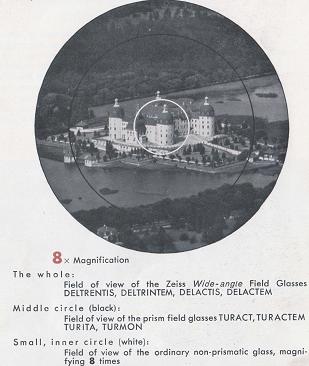
Field of view can be illustrated as an angle or a visible width of field’s cover at 1000 meters. Field view pipil - 12%for web

On the picture from Zeiss catalogue *) - the plate is showing the fields of view: wide angle field glasses (whole circle); prism field glasses (black circle), and non prismatic glass (white circle).


*) ‘Zeiss Field Glasses’, published by Carl Zeiss Jena for -  General Distributing Agencies in All Principal Cities in The World - June 1931. The catalogue is in our collection.

 Lens coating
Coating helps to reduce reflected light, and increase the percentage of light reaching the eye. The lens coating was not available on civilian binoculars before the war. The lens coating was available on some military binoculars from late 1935, only in Germany, not on a Swedish contract or export models. Some models are marked with a letter ‘T’ indicating a coated optics. Not all coated binoculars were marked with a ‘T’ letter. Later on the coated binoculars were mostly not marked with  the letter ‘T’.


Page Back                                                       Page (1) (2)